
Before the War
Van Gilse received his early musical training in Rotterdam and
The Hague, going on to study composition and conducting with Franz Wüllner
in Cologne. He left for Berlin in 1902, where he completed his composition
studies with Engelbert Humperdinck.
As an organizer, van Gilse proved to be of exceptional importance to musical life in the Netherlands. He co-founded the Genootschap van Nederlandsche Componisten [“Society of Dutch Composers”] in 1911 and established the Bureau voor Muziek Auteursrecht (Buma, “Composers’ Performing Rights Society”] two years later. He chaired both organizations for many years. In 1935, he founded the Stichting Nederlandsche Muziekbelangen to promote the performance of Dutch music.
Van Gilse conducted the Utrechts Stedelijk
Orkest (USO) [“Utrecht City Orchestra”] from 1917 to 1921, where he
was greatly admired for his groundbreaking work. But when the composer
Willem Pijper launched a sustained and aggressively negative campaign
against van Gilse in his reviews published in the Utrechts Dagblad
newspaper starting in 1919, the sensational “Pijper versus van Gilse”
controversy was born. Van Gilse resigned as conductor. From 1922 to 1933,
he lived in self-imposed exile in Switzerland and Berlin. Nazism was on
the rise in Germany, however, and he no longer felt at home there;
consequently, he happily accepted a post as principal of the Utrecht
Conservatory in 1933.
He relinquished the position in 1937 to
devote himself to composing, guest conducting with various orchestras, and
matters relating to BUMA.
During the occupation, van Gilse became increasingly isolated. He continued to dismiss the German Nazi regime out of hand, thus refusing to join the Kultuurkamer ["Dutch Chambre of Culture"], and became more and more deeply involved in the artists’ resistance movement. He was hardly able to compose anymore. He was forced to go into hiding in 1942 to avoid being captured by the Germans. “One is moved to think that Jan van Gilse dragged with him to all his hiding places three heavy folio volumes, scores of his opera Thijl. Always on the lookout for him, the Germans decided they would locate him by banning his work and seizing and destroying his music wherever they could lay their hands on it.” [1]
“From various hiding places, van Gilse continued to edit the underground
periodical he had established called De vrije kunstenaar ["The
Free Artist"], but after a few months, he had to give up this work because
he was no longer reachable after changing locations so often. From 1943 to
1944, his two sons, both of whom were active in the resistance, were
killed, a loss from which van Gilse never recovered. At his eighteenth
hiding place, at the home
of fellow composer Rudolf Escher, he fell ill.
He died at the hospital in Oegstgeest on September 8, 1944, after having
been admitted under a false name.” [2]
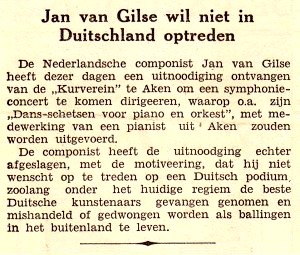
(source: Netherlands Music Institute, undated)
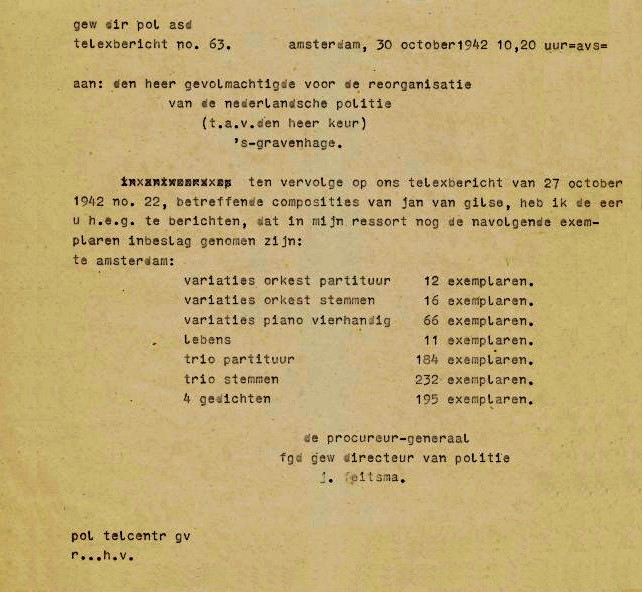
War Compositions
Van Gilse started work on his opera Thijl in September
1938, a dramatic legend that took the form of a prologue, three acts, and
an epilogue. The work is based on the “heroic, cheerful, and glorious
adventures of Uilenspiegel and Lamme Goedzak in Flanders and elsewhere” by
Charles de Coster. The libretto was written by Hendrik Lindt. In the
original score of this impressive work, van Gilse penned the dedication
“To the fighters for justice and liberty.”
“On November 29, [1940], van Gilse completed this work, now considered his
finest creation. On December 5, he wrote to Lindt, ‘Thijl is
finished! I am overjoyed to have been able to bring my work to a good
conclusion. The music between the third act and the epilogue is - I
believe - particularly successful; it is lamentation music for Thijl, who
is presumed dead.’” [1] During the occupation, van Gilse, who had
been born in Rotterdam, only managed to work on a declamation for speaking
voice and orchestra entitled Rotterdam, set to a text by Jan
Prins. The composer was unable to produce more than twenty-seven pages of
the score, leaving the work unfinished, as a result of the adverse
circumstances in which he found himself in 1942.
After the War
After the war, the Stichting Nederlandsche Muziekbelangen
and BUMA evolved into such institutions as the Stichting Donemus and the
BUMA Foundation. Jan van Gilse was the spiritual father of these leading
music organizations, which have provided considerable support to many
generations of post-war composers in the Netherlands. He continues to live
on posthumously through these organizations and through his music, in
which there has been a renewed interest over the last few years.
Author: Geert van den Dungen
variations orchestra music score: 12 copies, ..." (source: NIOD/Archive DVK)