Marianne Oswald's parents were Jewish immigrants,
exiles from Poland. Both parents died young and she became an orphan in 1917 at
the age of 16. Initially she was sent to a boarding school in Munich, but by
1920 she found her way to Berlin where she began singing in the thriving
cabarets of the period. During this time, an operation to remove a goiter—she
called it "having my throat cut"—left her with a permanent hoarse voice which
would have a major, and not entirely negative, effect on her singing career.
In 1931, with the rise of the Nazi party, and the threat it posed—Oswald was
after all Jewish—she was forced to emigrate to Paris where she forged a unique
new style of French singing incorporating the techniques of German expressionism.
She sang at the cabaret Le Boeuf sur le Toit (the ox on the roof), a tavern
which had long welcomed the songs of the French avant-garde. She was one of the
first to interpret The Threepenny Opera by Berthold Brecht and Kurt Weill, with
lyrics adapted into French by André Mauprey, for instance singing La complainte
de Mackie (a song English speakers know as Mack the Knife) and Pirate Jenny.
It was said that she had no voice, that she had an accent you could cut with a
knife, that she was too skinny, that she was not beautiful, that her voice—by
turns raw and tender—was bizarre and even shocking. It was all true. Moreover
she sang about depressing subjects—unrequited love, despair, death, and even
suicide. And yet, her red hair, her intensity, and the uniqueness of her singing
with its peculiar diction and spoken-sung style—in those days an innovation—earned
her the nickname "magnifique de Marianne la Rouge" (the magnificent redheaded
Marianne). Many years later, the French singer Barbara records in her memoirs
her amazement when a friend introduced her to this artist "fierce, modern,
desperate, staggering".
In June 1932 she made her first two recordings—with the recording company
Salabert: En m'en foutant (In did not care) and Pour m'avoir dit je t'aime (I
love you for telling me). She attracted the attention of Jean Bérard, president
of Columbia Records France, and this led to her recording two songs written by
Jean Tranchant, La Complainte de Kesoubah and Le Grand Étang. (Tranchant would
later write the songs Appel and Sans repentir especially for her.) Then in 1934
Jean Cocteau wrote for her Anna la bonne, a "spoken song" inspired by the
sensational news story of the Papin sisters, two servants, who in 1933
senselessly massacred their employers, mother and daughter. Anna la bonne would
later be the basis for a 1959 short film of the same name starring Oswald and
directed by Claude Jutra. In March 1934 she recorded Le Jeu de massacre, with
lyrics by Henri-Georges Clouzot and music by Maurice Yvain. In 1936 she recorded
another Cocteau composition, La Dame de Monte-Carlo.
In 1934, when Oswald sang Jean Tranchant's composition appel (the summons), with
its pacifist theme, she was booed off the stage by anti-semites in the audience.
The poet and screenwriter Jacques Prévert immediately came to her defense, and
this encounter was the beginning of a long and fertile collaboration between the
poet and the singer.
Later in the summer of 1934, another shocking news story captured the attention
of Jacques Prévert. Thirty children had escaped from a prison in
Belle-Ile-en-Mer where they had been tormented by sadistic guards. A reward of
twenty francs per child was offered to help recapture the miscreants, and
ordinary citizens actually joined in the hunt! Prévert responded by writing a
poem, La chasse à l'enfant (The hunt for the child), which was set to music by
Joseph Kosma, and recorded by Marianne Oswald in October 1936. Prévert also
intended to make the story into a movie, but this never came to pass.
In 1935 Oswald married a Monsieur Colin, a Catholic-born Frenchman. But their
union did not survive the war and the racist laws characteristic of the period.
In December 1937, the exclusive contract with Columbia ended with Oswald
recording one final song written by Prévert and Kosma, The sounds of the night.
Until 1939 Marianne Oswald could be heard at the Le Boeuf sur le Toit, at the
Alcazar, at Théâtre des Deux Ânes, and at Bobino. In 1939, she went into exile
in the United States where she performed in nightclubs and on radio, and was
sponsored by men such as Malcolm Cowley, John Erskine, and Langston Hughes.
While in the United States, she published a memoir in English, One small voice,
in 1945. All together, she remained in America for almost seven years.
In 1946 she returned to France. During her six years of exile in America, the
taste of the Parisian audience had changed. Marianne Oswald's outré style was no
longer welcome in the cabarets. She turned to radio and was the subject of a
series of programs presented by Cocteau, Camus, Seghers, Ribemont-Dessaignes,
Gaston Bonheur, and television producer/director Jean Nohain. Titled The Return
of Marianne Oswald, she sang and recited the works of Apollinaire, Paul Éluard,
and, of course, Prévert.
In 1948 she published an expanded version of her memoirs in French under the
title Je n'ai pas appris a` vivre (I have not learned to live), with a preface
by Jacques Prevert.
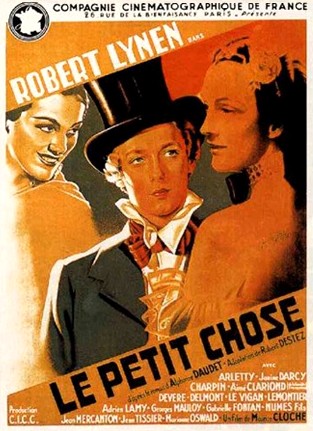
In 1938 Marianne Oswald began her acting career with Le petit chose (The Little
Thing) directed by Maurice Cloche. All together she appeared in seven films
between 1938 and 1958. She was especially noted for her performance in the 1949
film Les amants de Vérone (The Lovers of Verona), directed by André Cayatte and
written by Cayatte and Jacques Prévert. She was a sometimes screenwriter,
writing the screenplay for La première nuit in 1958, and a television short,
Bouquet de femmes in 1960. Working with Remo Forlani, she also produced
television programs for children, in particular, Terre des Enfants (Children of
Earth)
For over thirty years Marianne Oswald lived in a room at the famous Hôtel
Lutetia on the Left Bank in Paris, a hotel which ironically had served as the
headquarters of the Gestapo during the war. When she died in 1985 at the age of
84, at the hospital in Limeil-Brevannes in the Val-de-Marne, few people attended
the funeral. Six years later, in June 1991, her remains were returned to her
hometown of Sarreguemines. A plaque with her name was affixed to the corner of
Church Street and Rue de Verdun, at the very spot occupied by the building in
which she had been born, and which had been destroyed during the war.
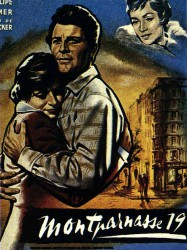
Réalisé par Jacques Becker,
Max Ophüls
Genres Drame
Thèmes Peinture
Acteurs
Gérard Philipe,
Lilli Palmer,
Lino Ventura,
Lea Padovani,
Anouk Aimée,
Gérard Séty
Le film raconte les dernières années d'Amedeo Modigliani, de la fin de la Première Guerre mondiale à sa mort en 1920, à Montparnasse, qui est à l’époque en plein essor artistique.
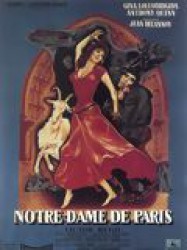
Réalisé par Jean Delannoy
Origine France
Genres Drame
Thèmes Religion
Acteurs
Gina Lollobrigida,
Anthony Quinn,
Alain Cuny,
Jean Danet,
Robert Hirsch,
Valentine Tessier
À Paris, sous le règne de Louis XI, la belle bohémienne Esméralda, qui danse sur le parvis de Notre-Dame, fait tourner la tête à Claude Frollo, sinistre alchimiste, à Quasimodo, sonneur bossu des cloches de la cathédrale et recueilli par Frollo, à Gringoire, poète, et à Phœbus, capitaine des archers. Elle vit une courte relation avec ce dernier, puis s'habitue à Quasimodo et en tombe amoureuse. Mais les moyens qu'il met en œuvre pour la garder pour lui vont les perdre tout deux.
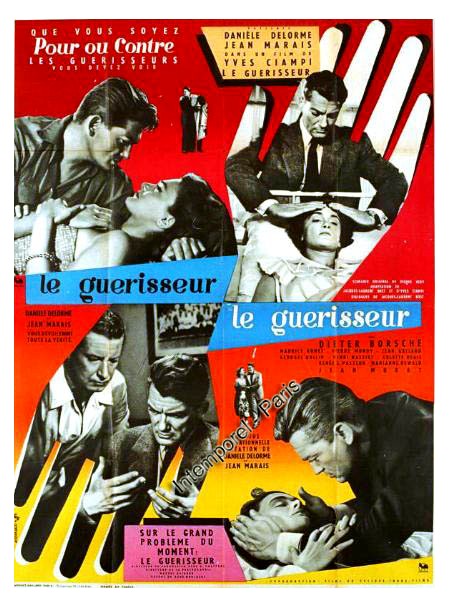
Réalisé par Yves Ciampi
Origine France
Acteurs
Dieter Borsche,
Jean Marais,
Danièle Delorme,
Maurice Ronet,
Jean Murat,
Jean Galland
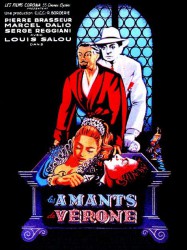 Les Amants
de Vérone (1949)
Les Amants
de Vérone (1949)Réalisé par André Cayatte
Origine France
Genres Drame
Thèmes Roméo et Juliette,
Adaptation d'une pièce
de théâtre,
Adaptation d'une pièce
de théâtre de William Shakespeare
Acteurs
Serge Reggiani,
Anouk Aimée,
Pierre Brasseur,
Martine Carol,
Marcel Dalio,
Marianne Oswald
Peu après la guerre, on tourne à Venise une adaptation de Roméo et Juliette. En marge des protagonistes, deux jeunes gens vont vivre à leur tour le drame de Shakespeare : Angelo, verrier à Murano, Georgia, fille d'un magistrat fasciste. Ils doublent les vedettes du film et vivent un amour incertain et toujours menacé, en particulier par les intrigues du louche Raffaele, rabatteur de la famille Maglia. Angelo est tué et Georgina meurt à ses côtés.
| Documentaires |
|