
http://www.angelfire.com/music2/reneleibowitz/rl.html
RENE LEIBOWITZ was born in Warsaw on February 17, 1913. "His musical career began with the study of the violin at the age of five. Between the ages of nine and thirteen he gave violin recitals in Warsaw, Prague, Vienna and Berlin, but his father decided to end his premature concert career, since he wanted his son to lead a normal life and not that of a child prodigy. On no account, however, did this diminish young Leibowitz's interest in music. In fact, he continued his daily practice and began to conduct as a young student in Berlin" (Readers Digest). Eventually he made Paris his home. There he studied composition with Ravel and Schoenberg, and also studied orchestration with Ravel. Additionally, he studied composition with Webern and conducting with Pierre Monteux.
Rene Leibowitz made his debut as a conductor in 1937 with the Chamber Orchestra of the French Radio in Europe and the United States. In 1944 he taught composition and conducting to many pupils, including Pierre Boulez (composition only), Antoine Duhamel, and Vinko Globokar. "Meanwhile, he continued to conduct whenever he found time - though his podium activities were interrupted by the war. It was during this period that he wrote several books concerning the music and techniques of the Schoenberg school - theoretical works which are classics of their kind. Also, during the war he was an active member of the French resistance against the Nazis. Upon the conclusion of the war, he returned to conducting - reluctantly at first. He felt that in his five-year enforced retirement he might have lost his touch as a maestro. This proved to be totally untrue. Soon after his return to the conducting world, he became one of the most sought-after directors in Europe. Attesting to his international success is the fact that his list of recordings is well over the hundred mark" (Readers Digest).
Rene Leibowitz's repretoire as a conductor spanned virtually everything, including opera, from the Baroque to the most modern 20th century composers. "Stamped by the spirit of the Viennese school, he considered faithfulness to the music as the highest standard of interpretation, a principle which must have collided head-on with the romantic ideals of contemporary concert practice. His achievements as a conductor were unique because of the uncompromisingness with which he expressed the modernity of the classical composers as well as the roots of modern composers in the traditions of the past" (quote by Sabine Meine).
Leibowitz was also known as an orchestrator. His arrangement and recording of Bach's Passacaglia and Fugue in C minor for double orchestra is just one of the unique achievements of his in this area. His most famous orchestration is his re-orchestration and recording of Mussorgsky's Night on Bare Mountain. Apparently the maestro had reservations regarding several aspects the famous Rimsky-Korsakov version. He even made a special trip to Russia to study all the available manuscripts before creating his own rendition. Leibowitz completely eliminated the fanfares, as well as implemented many other orchestral and musical changes. RL's version ends with a huge crescendo, and is quite powerful.
"I was a violinist in the UW Symphony in a performance of the Schoenberg Violin Concerto with Rudolf Kolisch, Violin Soloist and Rene Leibowitz conducting. We also did Beethoven's 9th. He was very professional, sophisticated, mild mannered and low key. One always felt very comfortable in his presence."
"I also was in a Seminar on Schoenberg's Chamber music co-taught by Kolisch and Leibowitz. It was a very special experience given both of their close acquaintances with Schoenberg."
-Eugene Fellin
"I think of Leibowitz on a par with my favorite conductor, Scherchen. As did Scherchen, Leibowitz conduced more with passion and internal response to music rather than by rote or score. This makes him consistently interesting. Like Scherchen, Leibowitz did indeed suffer from quick takes, under rehearsing and budget restraints. Despite this, his prowess and musicianship shines through. I've rarely, if ever, been disappointed listening to Leibowitz."
-Diane Kunza
"Too bad Leibowitz is so relatively unknown today, but some of us know better. Here are my recommended recordings:
Beethoven Symphonies, Royal Philharmonic (Chesky): I've been through at least a dozen complete sets, and many more single discs of course. This is one the few truly great sets. Recorded for Reader's Digest in the early 60's by Decca's superstar team of Gerhardt and Wilkinson, the sound quality is fully up to the best of the period. The basic approach is fast, bold, brassy, and incisive; played with tremendous power, a real feeling of spontaneity, and wonderful detail. Imagine the drive of Toscanini but with more imagination. The RPO plays everything as if they're having a wonderful time; brass players in particular (love those horns!) must have loved to play for Leibowitz. No's 2,4 and 8 are right with my all time favorites, and 3, 5, and 9 are on my desert island list. Incredible power in the Eroica, with horns blazing away. 5/1 is maniacal in its intensity, and the end of the finale cuts loose with a thrilling brass volley. The scherzo of the 9th alone would make it worth the price of the disc, completely unique. If you like your Beethoven "con brio" go for it. I've read criticisms of the Leibowitz set complaining of a lack of technical precision in the playing. There's nothing in the entire set that bothers me in the least, and nothing to compare with even the very opening bars of a Furtwangler 5th (and I'm a fan). Anyone interested in technical perfection has dozens of unimaginative, very precise, ultimately boring performances to chose from.
Another must on Chesky: Wagner - Tannhauser Overture, Liszt - Mephisto Waltz, and Schumann's 3rd 'Rhenish' Symphony. The best Schumann symphony recording in my collection, and one of the great recordings of anything. Why is this so unknown? Collecting dust on my shelves are highly regarded recordings by Bernstein, Solti, Sawallisch, and Goodman. Like the Beethoven, fast and powerful, with thrilling brass playing.
'A Portrait of France', also on Chesky. Great collection of popular French stuff, that includes the most individual Bolero you're likely to hear.
Leibowitz is a shamefully underrated conductor, who put an individual stamp on everything he recorded."
-Chris Guris
"CONGRATULATIONS for the leibowitz-site! Terrific achievement, gorgeous, fascinating! One of the four or five greatest conductors of the 20th Century has at last got (if not yet the attention and respect that he earns)at least a site..."
-Thrassyvoulos Papadopoulos; Kiel, Germany
"The Leibowitz-arranged Bach Passacaglia is just mesmerizing! Bach himself would approve with delight; you know Rene's touch, especially with older music (Beethoven and earlier) He doesn't overdo anything. In the case of the Bach, each phrasing and grouping has definite purpose; they have Rene's touch all over them, but again they are really unchanged in any real technical way from Bach's original composition. It is seemingly as the great work was originally composed. But yet Rene L. has somehow magically rendered this piece more accessible in a modern kind of way. It's one of Leibowitz's supreme talents. Contemporary people living in these modern times would have no problem relating to it at all. This is indeed something special. (Rene L. is so terribly underrated, it is almost a crime. We need more recordings!) As the yrs. go by, this is more and more the way I often like to hear this kind of music. I personally think the Bach arrangements are better than his "Night on Bare Mountain" and that Is hard to top. Rather than blather on my opinions any further, I think I'll quote you something better and far more informed, Charles Gherhardt: 'Few compositions invite restatement and expansion as this one does. Rene Leibowitz was preceded in this tempting and exciting role of arranger by Esker, Goedicke, Stock, Respighi and Stokowski. What the arranger has done here is to use and maintain the effect of two separate orchestras. They are divided in space, but there is of course complete contact and integration between them. The arrangement is one more tribute to the diverse genius of Bach.'
Well, both recording and performance is full, and rich, and simply just wonderful, as you can imagine two orchestras conducted in complete control with a master at the helm would be, especially given the RCA / Wilkenson Royal sonic treatment. And I love the double timpani whacks at the ending!"
-Ralph Harris
From the original LP jacket - Everest Couterpoint/Estoteric records production:
[The widow of Albert Roussel of the two works on this long playing disc attended both recording sessions: 'Sandman' at Salle Pleyel-Chopin, and 'The Spider's Feast' at l'Ecole Normale de Musique; and expressed her sentiments in the following letter to Rene Leibowitz:]
"Dear Maestro,
At the twilight of my life it has been one of the greatest pleasures for me to attend the recording sessions of 'The Spiders Feast' and 'The Sandman'; The latter is such a little-known work that it seems to me like a reflection of our youth - Albert Roussel's and my own.
During the recording of 'The Spider's Feast," I remembered thinking about the letter from my husband which I received in the very remote past; this is what he wrote:
(quote) Je ne sais pourquoi le theme du jardin du 'Festin de l'Araignee' me revenait obstinement a la memoire et m'obsedait; tu sais, le theme du debut du prelude que la flute disait si timidement par-dessus le murmure des violins. (end quote)
To this recollection a profound emotion was added. I felt the spiritual dedication of these young musicians, united in vibrant enthusiasm, bringing before the public these works of Albert Roussel.
To you, dear Maestro, I express a conscious and very sincere gratitude, for, beyond the prestige of the musician, you have discovered the poet."
-(signed) Mme. B. Albert Roussel
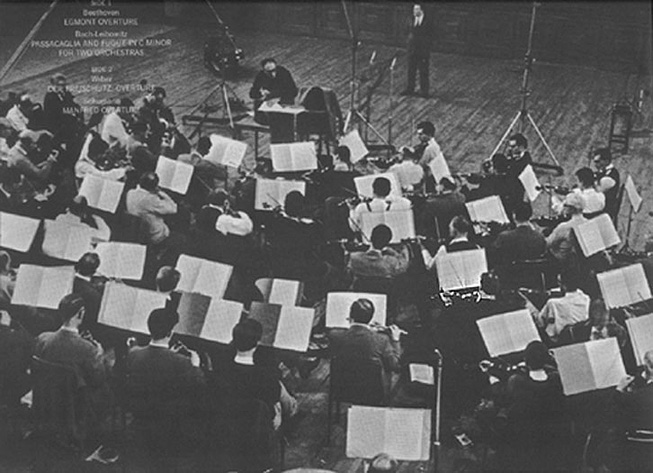
(Rene Leibowitz with the Royal Philharmonic 196?)
"What mere words could ever do justice to the great Maestro? The ones of us who truely love and know him have done so by something far beyond words. Perhaps a spiritual connection that his unique touch gave to all of the music he touched thereby touching us. His work is wonderfully unique and inspired. Rene has struck awe in me since I was a young teen in the early 60's, playing trombone and listening to all of the classical music I could get my hands on. After extensive travel and research of all the Moussorgsky and Rimsky-Korsakoff material, he wrote a new version of A Night on Bare Mountain, released in 1963 RCA RedSeal which is simply glorious. With Ravel's orchestration of Pictures at an Exhibition on the other side, all performed by the Royal Philharmonic, this is my "stranded on an island" pick. It has moved me to tears of sheer joy and memory for nearly 40 years. Rene had a special and wonderful gift in his heart and mind for music that few have ever known. To hear him is to love him. To miss his special sound is to indeed suffer great loss."
-Larry Collingsworth
"The best Leibowitz I have heard is with his Paris Philharmonic Orchestra, which was his own and really a best fit. With that orchestra he exhibits a level of sophistication and delicacy of nuance second to none.
His absolute unrivaled masterpiece of conducting is his Roussel Spider's Feast, which is unrivaled, even by the likes of Ansermet, Toscanini (a complete miss), and Cluytens. That is one great recording.
His next greatest accomplishment: the tenor solo 'Froh, Froh' section from the last mov't of the Beeth. 9th, which is the only one I have ever heard where the tenor (Richard Lewis) really gets the euphoric abandon Beethoven wrote into his amazingly exact setting of those words. The rest of his 9th is variable, but up there with the best. That Tenor section, though, is worth the world. Total euphoria. I was amazed when I heard it."
-Mark B. Anstendig


Rene Leibowitz conducting the Royal Philharmonic (1961)
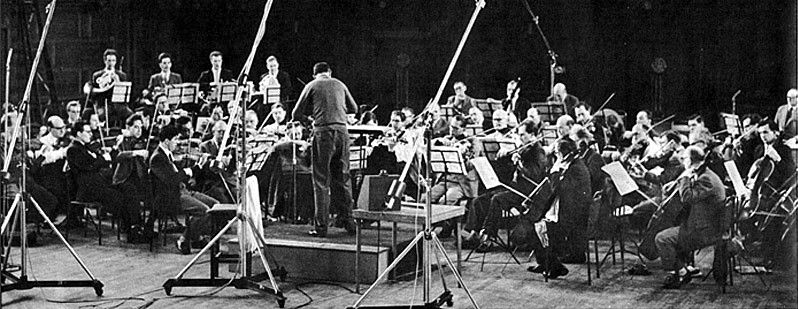
Rene Leibowitz with the Royal Philharmonic (1961)
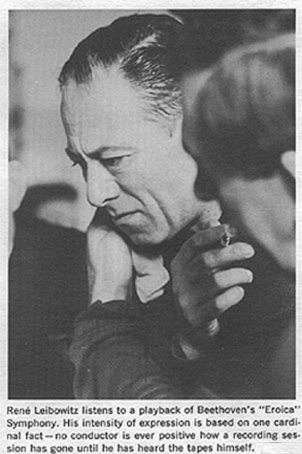

(Rene Leibowitz, Charles Gerhardt (middle), and Kenneth Wilkinson (left) in
1961 Beethoven recording session)
AUBER:
BACH:
BEETHOVEN:
BERG:
BERLIOZ:
BIZET:
BOCCHERINI:
BORODIN:
BRAHMS:
CHABRIER:
CHOPIN:
CORELLI:
DEBUSSY:
DELIBES:
DONIZETTI:
DUKAS:
DVORAK:
FALLA:
FAURE:
FRANCK:
GADE:
GERSHWIN:
GILBERT-SULLIVAN:
GLUCK:
GOUNOD:
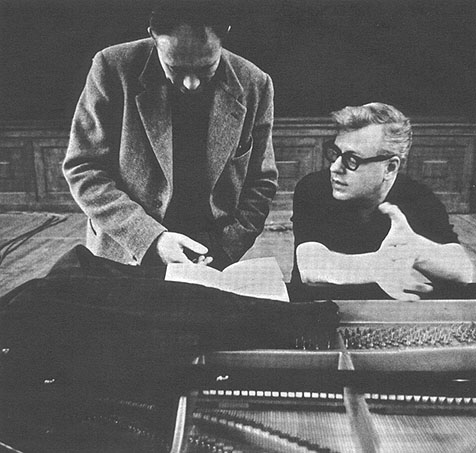
(Rene Leibowitz and Earl Wild discuss the tempos for the Grieg concerto
before the recording session starts)
GRIEG:
HAYDN:
HEIFETZ:
IBERT:
IPPOLITOV-IVANOV:
LISZT:
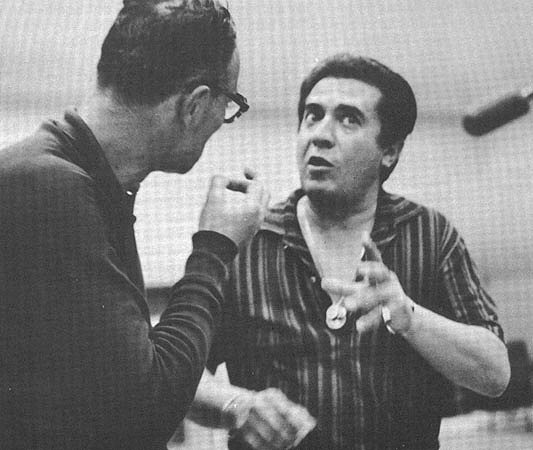
(Rene Leibowitz (left) and Giuseppe Di Stefano share some thoughts in the
recording of "A Portrait of Manon" 1963)
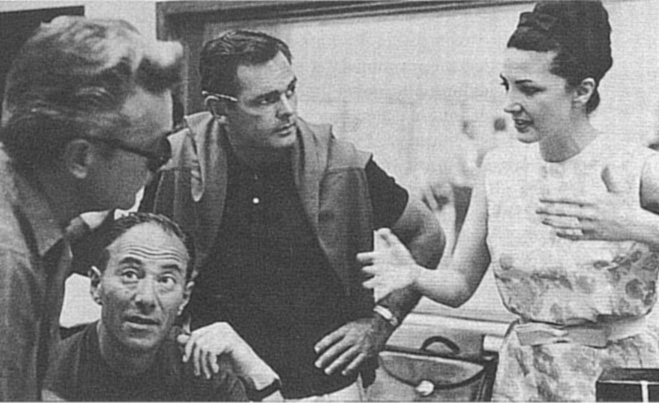
(Rene Leibowitz, producer Richard Mohr, Anna Moffo, and Robert Kerns share
insights during the recording of "A Portrait of Manon" 1963)
MASSENET:
MENDELSSOHN:
MEYERBEER:
MOZART:
MUSSORGSKY:
OFFENBACH:
PIERNE:
PROKOFIEV:
PUCCINI:
PUIG:
RAVEL:
RIMSKY-KORSAKOFF:
ROSSINI:
ROSSINI-RESPIGHI:
ROUSSEL:
SAINT-SAENS:
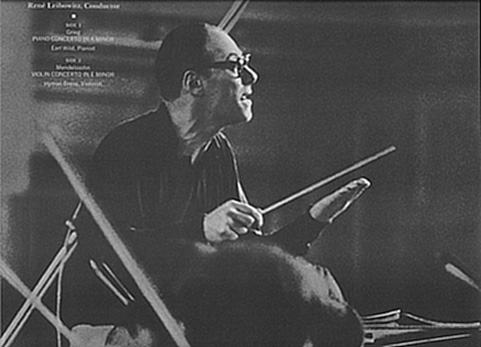
(Rene Leibowitz again leading the Royal Philharmonic - 196?)
SATIE:
SCHOENBERG:
SCHUBERT:
SCHUMANN:
SIBELIUS:
JOHANN STRAUSS:
STRAVINSKY:
SULLIVAN:
TCHAIKOVSKY:
TELEMANN
THOMAS:
TRADITIONAL:
VERDI:
WAGNER:
WALDTEUFEL:
WEBER:
WEBERN:

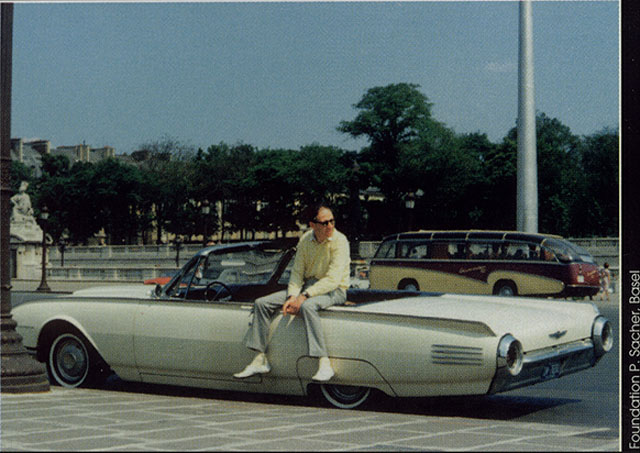
Rene Leibowitz with his Ford Thunderbird in Paris (1961)
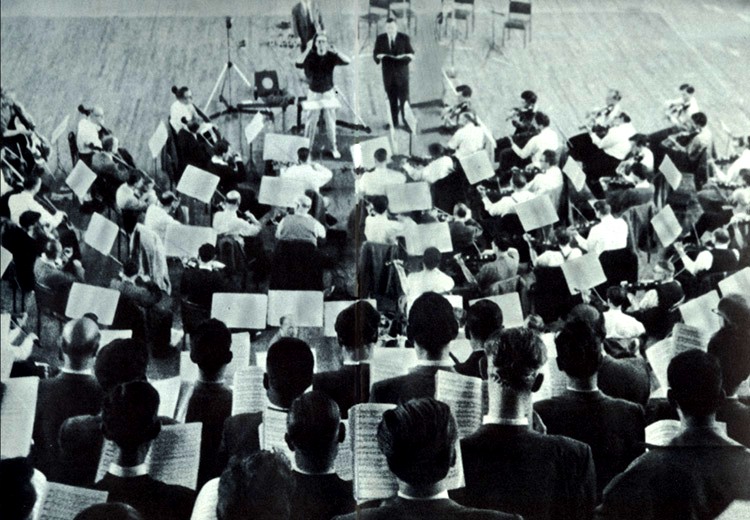
"Two hundred and fifty performers are gathered together for a mammoth recording session of Beethoven's Ninth. The work's subtitle, 'Choral,' derives from the fact that it is the only symphony Beethoven wrote which included either a chorus or vocal soloists. Assembled in front of the chorus is the orchestra, the largest Beethoven ever required. Standing at the helm of the whole massive operation is conductor Rene Leibowitz, who naturally was responsible for coordinating the entire operation. It is a task not easily undertaken, since Beethoven's Ninth Symphony is the pinnacle of all his works and one of the most stupendous pieces of music ever conceived by man. Also, it is one of the most difficult to conduct. Watching every note played or sung by two hundred and fifty musicians is a formidable challenge. But when this challenge is well met the resulting experience for the listener is overwhelming" (from Readers Digest - on this picture with Rene Leibowitz, the Royal Philharmonic, and the Beecham Choral Society at Walthamstow Town Hall, England 1961).