Part prophecy, part educated guess, None Shall Escape is a one-of-a-kind film: the only wartime Hollywood production to depict what would later be called the Holocaust
- a flash-forward to an unimaginable event somehow
imagined on a backlot at Columbia Pictures in 1943. Viewed today, the machine-gun slaughter of a group of Polish Jews being rounded up for deportation and herded into boxcars plays as docudrama.
In its time, it must have seemed wild fantasy or jingoistic propaganda.
Unavailable on (legal) DVD, seldom screened on the repertory circuit, and cropping up only sporadically on TCM, a serviceable 35mm print of
None Shall Escape is now in circulation. It played in May at the Los Angeles Jewish Film Festival and will be shown tonight, Nov. 1, at the
Wasserman Cinematheque at Brandeis University. The 35mm screenings are prelude to a full-on restoration for Home Entertainment release and on DCP for wider theatrical exposure by Sony Pictures.
Directed by Hungarian émigré Andre DeToth, shot by ace cinematographer Lee Garmes, and scripted by Lester Cole from an original story by Joseph Than and Alfred Neumann,
None Shall Escape was an ambitious, albeit low-budget, project from the often B-movie-class specialists at Columbia Pictures. After a couple of title
changes (in preproduction the film was called The Day Will Come, and then Lebensraum), the studio settled on None Shall Escape, a callback to a promise made by FDR to bring Nazi war criminals to justice.
Shot and edited from Aug. 31 to Oct.
26, 1943 (not until June 6, 1944 would the Allies storm the beaches at Normandy),
the film looks forward to a postwar reckoning in which a United Nations-like
Tribunal sits in judgment of a Nazi war criminal whose twisted course is traced
in flashback from 1919 onward. “The time of our story is the future,” reads an
introductory scroll. “The war is over. As was promised, the criminals of this
war have been taken back to the scenes of their crimes for trial. In fact, as
our leaders promised” - and here the screen devotes full frame to the boldfaced
imperative - “None Shall Escape.”
***
Three witnesses, all aged and beaten-down
survivors of Nazi-occupied Europe - a village priest, the defendant’s brother, and
his former fiancé - unreel the life of a brutal SS officer whose story stands for
the descent of a nation into savagery from civilization.
Wilhelm Grimm (Alexander Knox, in his
screen debut), a German teacher in a folksy Polish village, returns after four
years in the trenches of the Great War. He has come back a changed man,
physically (lost leg) and psychologically (embittered, already infected with a
toxic poison born of defeat). He spews venom at the doltish Polish peasantry, a
breed inferior to the glorious Aryan. Understandably, the attitude alienates the
affections of his Polish fiancée Marja (Marsha Hunt), who breaks off their
engagement. Because he can, Grimm seduces a smitten schoolgirl who, disgraced,
commits suicide. Despised by the village, he turns to two men of the cloth - a Catholic priest (Henry Travers) and a Jewish rabbi (Richard Hale)
- to lend him
money so he can flee to his native Germany.
 (IMDb)
In Munich, a new philosophy and a new
leader offer an outlet for Grimm’s sadistic streak. Already an
Alter Kämpfer, he participates
in the Beer Hall Putsch and serves time in Landsberg Prison with the man writing
Mein Kampf in the cell directly
above his. Grimm’s ruthless will to power is rewarded with quick promotion in
the Nazi hierarchy and the attendant perquisites of power. He does not hesitate
to consign his brother, a liberal journalist for a socialist newspaper, to a
concentration camp, or to indoctrinate his nephew into the black arts of Nazism.
In 1939, when the Nazis invade Poland,
Grimm is appointed Reichskommissar of the town he fled from in disgrace. With
his Nazified nephew as right-hand man, he orchestrates a campaign of vengeance
and oppression. The girls of the town are taken to the “officers’
clubhouse” - code for brothel - “for recreational purposes.” The Jews are beaten and
rounded up for deportation.
Shot in noirish night-for-night
photography, the deportation sequence shows the Jews of the village, and a
shipment from Warsaw, being herded into box cars for transport to what can only
be a death, not concentration, camp; the wails of the terrified victims ring out
on the soundtrack. Grimm orders the rabbi to quiet his people, but the man has
no intention of facilitating the Nazi depredations. Richard Hale, the actor who
plays the rabbi, would later accrue countless credits as a character actor in film and television, but he never again commanded a moment so powerfully as in this, his first screen role.
Framed in close-up, with minimal cutaways, he delivers a searing indictment of anti-Semitism and a rousing call to arms:
My people! Be calm. Listen to me.
Let’s prepare ourselves to face the supreme moment in our lives. This is our last chance. It doesn’t matter if it’s long or short. For centuries we have sought only peace. We have submitted to many degradations believing that we will achieve justice, for a reason. We have tried to take our place honestly and decently alongside all mankind to help make a better world, a world in which all men would live as free neighbors. We had hoped, and prayed. But now we see that hope was not enough. What good has it done to submit? Submission brought us rare moments in history when we were tolerated.
Hale spits out the next words:
Tolerated! Is there any greater degradation than to be tolerated? To be permitted to exist? We have submitted too long. If we want equality and justice we must take our place alongside all other oppressed peoples, regardless of race or religion. Their fight is ours. Ours is theirs.
The actor pauses a beat:
We haven’t much time left. By our actions we will be remembered. This is our last free choice. Our moment in history. And I say to you let us choose to fight! Here! Now!
The Jews run from the box cars and
attack their guards, but the cause is hopeless: In an extended and excruciating
bloodbath, the rebels are mowed down by Nazi machine guns. After the massacre,
the unbowed rabbi tells Grimm, “We will never die - it will be you, all of you!”.
Grimm shoots him point blank in the stomach, but the rabbi is a hard man to kill. As the camera scans the bodies
strewn on the ground and in the boxcars, he stands up and recites
kadish over his people.
This being classical Hollywood cinema, even a proto-Holocaust film must have some boy-girl stuff. Grimm’s nephew has
fallen in love with a local Polish girl - Marja’s daughter. When she is shot at
the “officers clubhouse,” presumably for resisting rape, the sight of her dead
body ignites the nascent decency in the boy. As he walks to an altar to pray
over her body, he rips off the Nazi insignia from his SS uniform. Grimm shoots
him in the back.
Returning to the diegetic present, in
the courtroom, Grimm is unrepentant and defiant. “You cannot crush us!” he yells
at the tribunal. “We will rise again!”
Surprisingly, the film denies us the
satisfaction of a Nuremberg ending: the hissible Nazi war criminal is not hanged,
not even sentenced. “You are the jury,” the presiding judge says into the
camera. It is left to us, the custodians of the postwar world, to render a
verdict.
***
None Shall Escape was stark,
depressing stuff for wartime audiences already overloaded with stark, depressing
stuff in the newsreels. Whatever satisfaction might be taken from the prospect
of an assured victory was more than tempered by the litany of Nazi horrors and
the future necessity of dealing with the perpetrators.
Early reviews speculated that the
story was based on “the career of notorious anti-Semite and pornographer, Julius
Streicher,” publisher of Der Stürmer,
but Streicher, for all his rabid anti-Semitism, never personally ordered the
killing of a Jew. No matter: the Nazis offered real-life models aplenty for
cinematic sociopaths and two of the creators of the film had firsthand knowledge
of the type.
Joseph Than, the co-writer of the
original story, was a German refugee who escaped to Hollywood from Occupied
France in 1941; he received the
Croix de Guerre for helping a pair of French soldiers escape the Nazis.
With playwright Alfred Neumann, likely the English language half of the writing
partnership, he rendered an on-the-ground account of a Nazi Occupation. Film
scholar Jan Christopher Horak, director of the UCLA Film and Television
Archives, notes that reports of Nazi genocide also filtered into Hollywood’s
sizable refugee community by way of
Freies Deutschland, a widely circulated German-language Communist newspaper
published in Mexico.
Like Than, director Andre DeToth, the
31-year-old Hungarian refugee who had come to Hollywood in 1942, brought a grim
expertise to the subject, being all too familiar with the killing field that was
Poland under the Nazi jackboot. In 1939, as a cameraman, he had been in Warsaw
and was forced by the Nazis to film propaganda scenes of starving Poles, whom
the Nazis lined up, whipped, and forced to smile for the cameras. He remained
traumatized by the memory - and his role in the fabricated footage - for the rest of
his life. “They showed these things all over Germany, all over the world,” he
lamented in an
interview in 1994. By way of catharsis, a nearly identical episode unspools
in None Shall Escape: the Nazis
corral hungry Polish villagers around a food wagon, order them to smile, and
dispense food for a propaganda film. After the newsreel cameraman gets the shot,
the villagers are rousted away.
Screenwriter Lester Cole was given
the assignment to adapt the story for the screen. Initially, Columbia Pictures
chieftain Harry Cohn had qualms about Cole, an out-front and party-line
Communist, figuring the writer would let dogma overrule drama, but associate
producer Burt Kelly and executive producer Sam Bischoff stood by their choice.
Cole thus got one the few chances he ever had in Hollywood to contribute to what
he deemed “a film that was important.” (In 1947, with nine like-minded comrades,
Cole would be cited for contempt of Congress, jailed, and rendered unemployable
for refusing to answer the $64,000 question posed by the House Committee on
Un-American Activities: “Are you now or have you ever been a member of the
Communist Party?”)
Cole admired Than and Neumann’s
original story (it was ultimately nominated for an Academy Award), but from his
point of view it lacked an essential element: agency. “The Jews were passive;
they went to their deaths without a struggle,” he recalled in his 1981 memoir
Hollywood Red. “True, some did;
but others did not.” Producer Kelly agreed that “passivity was horror but not
drama.” Hence, the rabbi’s defiant monologue.
Marsha Hunt - the great Hollywood
actress who played Marja and just celebrated her 99th birthday Oct. 17 - gave credit to the screenwriter. “God bless Lester Cole,” she told me recently,
recalling None Shall Escape
proudly. “It was a privilege to be in it,” she said. “We all felt very
passionately about the subject.” She remembered Cole as being outspoken about
his beliefs, but she is too modest to mention that so was she: Hunt was
blacklisted for years for her progressive activism. She is delighted that, after
decades in hibernation, the film is getting a second life.
Before being deemed fit for
exhibition, None Shall Escape,
like all wartime Hollywood cinema, had to pass muster with two censorship
regimes - the Production Code Administration (PCA) and the Motion Picture Bureau
of the Office of War Information (OWI). The PCA was responsible for morality,
the OWI for wartime values. Either could suck the lifeblood out of a gritty
drama.
Against expectations, the PCA passed
the film with barely a murmur of objection. The harsh realities of World War II
had inured even censors to the kind of material that might have once been
unthinkable - the level of casual brutality, the frank utterances of Nazi anti-Semitism,
and the scope of Nazi depravity. Predictably, the depiction of the seduction and
suicide of the Polish schoolgirl was the main focus of concern. “We believe this
element could be handled so as to be acceptable under the provisions of the
Production Code, provided of course, that there was no attempt to dramatize the
action further than what is already indicated in your outline,” PCA chief Joseph
I. Breen informed Harry Cohn during the preproduction vetting of the script.
Breen also suggested that the age of the girl be at least 16 years, “for obvious
reasons.” In good Codely fashion, Grimm’s crime is committed off-screen and
referred to so elliptically that a naïve viewer might not understand what had
transpired.
The Breen office knew that a more
formidable hurdle for None Shall
Escape - “on account of its unusual premise” - was the OWI’s Motion Picture
Bureau. The agency gave legally unbinding but culturally coercive advice to
Hollywood on how best to serve the war effort, examining scripts along
guidelines articulated in a 167-page guidebook,
The Government Information Manual for the Motion Picture Industry.
Even more than the Breen office, the
government film reviewers gave None
Shall Escape a bright green light. “I think there are potentialities in
this story for one of the greatest war pictures conceivable,” the Los Angeles
bureau head told producer Sam Bischoff after a once-over of an early script. “By
projecting the pledges made by President Roosevelt, Winston Churchill, and other
United Nations leaders, that those guilty of atrocities and violations of
international law will be tried and punished, new hope could be given to the
peoples of those countries now occupied by Axis forces.” Viewing the final print,
the bureau was no less upbeat: “The first picture dealing with the punishment of
Nazi war criminals to be made in Hollywood,
None Shall Escape has emerged
as a thoughtful and intelligent examination of this important postwar problem.”
Anticipating box-office gold and
critical acclaim, Columbia gave None
Shall Escape an elaborate publicity roll out, pre-releasing the film to 19
New England theaters prior to a national release on Feb. 3, 1944. To ballyhoo
the film, one enterprising exhibitor marched his ushers in mock-up Nazi uniforms,
wrists tied together in ropes, through the local Main Street. Naturally, though,
sexual not jurisprudential enticements dominated the ad-pub strategy. “Thank
heaven your daughter wasn’t there!” shouted the taglines. “But what about the
women who were there?”
Hollywood was just discovering the erotic menace of a Nazi in uniform - a trope that would serve postwar cinema, not to mention entire tributaries of the porn
industry, quite well in the years to come.
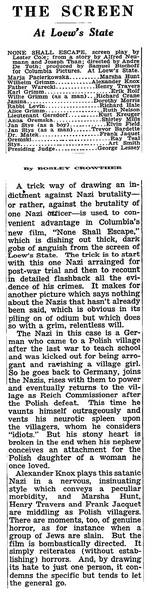 (New York Times archive)
Wartime critics could not help but be
impressed by the audacity of the project ( “If the film had no more than its ‘firstness’
with which to claim the interest, it would merit public attention,” observed the
Film Daily), but the critical
consensus was not all Columbia had hoped for. Though admitting the “precedentially
important” aspects of the film,
Motion Picture Daily felt that it “adds nothing consequential to the
technique of anti-Nazi pictures, but does raise the question of whether the
entertainment screen can deal successfully with postwar issues at this point in
the calendar.” New York Times
critic Bosley Crowther was struck by the moments of “genuine horror when a group of Jews are slain,”
but astutely dissected what would be a perennial Hollywood problem in depicting
the nature of Nazism: “By drawing its hate to just one person, it condemns the
specific but tends to let the general go.”
Despite the tepid response, Variety speculated that films
dealing with postwar problems would probably be “the screen’s next cycle.” It
was not to be: Powerful considerations militated against a cycle of postwar
films made during the war.
First, there was always the distinct possibility that a predictive scenario might be overtaken by events:
The Master Race (1944), written and directed by Lester Cole’s future Hollywood Ten comrade Herbert J. Biberman,
produced in the blush of confidence after D-Day and released in September 1944,
prematurely forecast a victory in Europe in November 1944.
Second, the moviegoing public wasn’t buying. Harsh, soul-searching melodramas about Nazis ruthlessly oppressing the
peoples of Europe made for a bleak night out in an era craving uplift and diversion.
Above all, assuring America that a victorious outcome was a foregone conclusion might lull the nation into
complacency. Why struggle and sacrifice if victory was a done deal? In
1944-1945, as the Nazis tenaciously fought the Allied advance, the OWI,
initially so enthused about the postwar forecasts, had second thoughts about
telling the homefront - and the men and women on the front lines - that the war was effectively over.
In June 1944, William R. Weaver, the Hollywood editor for the trade weekly
Motion Picture Herald, summed up the downside of prematurely postwar cinema. Hollywood producers, he reported,
“are leaving the blueprinting of the postwar world strictly to the politicians
and pundits whose blueprints cost them about a million dollars less than the
million dollars per copy which the producer would be compelled to pay for his
with no brighter prospect of seeing it adopted.” He referred to two additional
factors weighing against venturing into geopolitical prophecy. One was a
pertinent case in point: “Columbia’s experience with
None Shall Escape, which ran up
something of a box office record in reverse.” The other was the fact that
“Washington has let it be known that there’s no eagerness there to have
Hollywood touch the matter in any way.”
With no box office mandate and
understandable government resistance, Hollywood backed off. Best not to get too
concerned with the postwar era until the era was truly postwar, the surrender
documents signed and sealed. The industry would not chase after Nazi war
criminals again until after victory in Europe, notably in Orson Welles’s
The Stranger (1946), in which a
War Crimes Commission investigator played by Edward G. Robinson pursues an
architect of the Holocaust to a bucolic college town in Vermont.
Finally, an ugly experience
precipitated by None Shall Escape
must have made Hollywood uneasy, if not heartsick, for reasons that were closer
to home than war-torn Poland.
Variety was appalled to report that scenes in the film where the Nazis are
shown desecrating a synagogue and insulting the rabbi were “not
unsympathetically received by certain bigoted individuals in Brooklyn,
Philadelphia, and other localities. … Reports from some theaters said that
hoodlums applauded and cheered.”
Interreligious fellowships condemned
the antics, but the outbreak of brownshirt-like disruptions in stateside
theaters in the middle of WWII was a reminder of the homegrown version of the
hatred still thriving in Europe. The in-house anti-Semitism also pointed ahead
to a reckoning that, in the postwar era, neither Hollywood nor America could
escape.
***
Thomas Doherty last wrote for Tablet magazine about Nazi propaganda films.
Thomas Doherty, a professor of American Studies at Brandeis University, is the author of Hollywood and Hitler, 1933-1939.