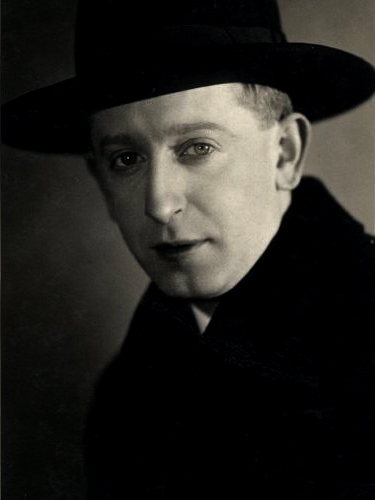
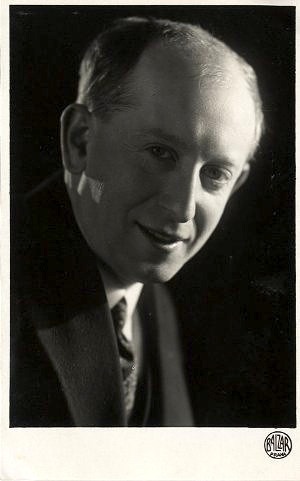
 Jaromír Weinberger Re-Discovered
Weinberger was one of the many thousands of
musicians displaced by the Third Reich. But,
musical considerations aside, his plight is
typical of a small percentage of people who
defy precise categorisation in terms ‘victim’
and ‘survivor’. To demonstrate the
significance of this distinction, I will
tell you the story of my involvement from
the beginning.
Back in June 2007, when I was living in
Iceland, I received an email from a former
student at the university at which I had
previously taught in the States, someone
with whom I have remained in contact. In his
message, he asked if I would come to Los
Angeles and play a saxophone concerto with
one of the orchestras of which he was music
director. I agreed and began to read through
the concerto literature to see what I might
recommend as a suitable suggestion.
Progressing alphabetically through the
repertoire on my shelves, I eventually came
to ‘W’. I placed my copy of the Weinberger
Saxophone Concerto on my desk and began to
play – and realised what a wonderful,
emotionally charged work it is (not to
mention technically demanding). Yes, I must
play this! I had owned that copy for nearly
35 years and barely looked at it in all that
time. Well, like I said, it
is technically demanding…
As I had only the solo part and piano
reduction, I began to search for the
orchestral materials and score on the
internet. But after many hours of looking, I
couldn’t locate these materials anywhere,
not even from the publishers, who informed
me that in fact they had never had them. So
I began a private investigation and within
two days located the score and parts in a
basement in South Dakota.
My interest was now piqued. Yes, I had known
the ‘Polka and Fugue’ from Weinberger’s
opera
Schwanda the Bagpiper – what high-school
band has not performed this chestnut of the
band literature at some point? Besides these
two works, I have to confess that I knew
nothing more about Weinberger but, if he
could write a concerto and an opera, there
was obviously something else out there.
That’s where my obsession began: since that
day I have spent all my time and resources
locating any and all materials relating to
Weinberger. I have travelled between
Jerusalem, Prague, Bratislava, Berlin, the
USA and beyond in search of this elusive
man. The more I learned about him, the more
questions I raised.
Four years ago I made a breakthrough: I
located five crates of materials that had
survived from his house in Prague when he
fled in 1935. Conservatively, it is the
largest single musical find of the last
hundred years. These sealed crates contained
not only manuscripts and sketchbooks, but
hundreds upon hundreds of letters from his
days as a student up until the last day he
ever spent in Prague. Although other scores
and letters survived (they are located in
the Weinberger Archive of the National
Library at Hebrew University in Jerusalem),
those materials pertain almost exclusively
to his exile in America from 1939 until his
death in 1967.
Among the materials that I located were
works that we never knew existed. He was so
traumatised by the life-events he had to
endure (his flight as a refugee through
Austria, France, England, Canada and finally
the USA; his mother and sister perishing in
a concentration camp; the loss of his home
and all his personal possessions and his
income; and then finally becoming
marginalised and, he felt, redundant as an
artist) that he suffered a series of mental
breakdowns and heart-attacks. For the rest
of his life he never spoke or wrote about
any event before 1935. That’s the main
reason that there has been so much
mis-information about his biography. I hope
we’ll now be able to correct the errors and
restore Weinberger to his rightful place in
musical history through musical editions,
recordings and writings.
Fate was obviously kinder to Weinberger than
to many other Jewish composers. But his
survival came at a cost: if he had suffered
the same destiny as Erwin Schulhoff and
Pavel Haas, for example, we would
undoubtedly have spent more time and
research into learning about him. To have
survived put him in a time and a place that
did not exist before the War, when he was
the toast of European musical theatre. The
world he entered held no interest for him
and reciprocally had no interest in him.
As a second-generation American of eastern
European Jewish decent myself, I grew up
hearing the stories of my own family’s
persecution: one half of the European side
of my family died in various concentration
camps in Poland, Austria and Hungary; the
other half fled to the USA, Cuba, Argentina
and beyond. I am not saying that sharing
Weinberger’s heritage has allowed his story
to resonate with me more than if I did not –
but it sure does help…
I began this quest on purely musical
principles – a musicological project that
was not only academic, but practical as well.
It has become historical and personal. The
forms it will take include a number of
recordings for Toccata Classics, now at the
planning stage, and the publication of his
letters in several volumes to appear from
Toccata Press; my editions of the music I
have discovered will be distributed by
Subito Music Corporation, based in Vermont.
I’ll shortly post a worklist here so that
you can see – for all that everyone knows
that ‘Polka and Fugue’ – just how of
Weinberger’s music remains to be heard.
Zristan Willems received his
formal music education at
Northwestern University where he
studied with members of the
Chicago Symphony, obtaining the
first degree ever granted from
that institution in Woodwinds
Performance. Subsequent studies
were taken at the Conductor's
Institute. His career has
touched virtually all facets of
the music industry: he has
performed and composed for the
theatre, been a member of
various orchestras in the United
States (performing on bassoon,
clarinet, oboe and saxophone),
is the author of over 500
compositions and arrangements,
owns a music-publishing house (Brazinmusikanta
Publications and Willemsmusiik),
has been vice-president of
Jeffrey James Arts Consultants
(an arts management firm), and
founded 4-Tay, Incorporated (recording
label). From 1994 until 2002, he
was Music Director and Conductor
of the Britten-on-the-Bay
Festival Chorus and Orchestra in
New York. Also in 1994, he
founded the Adolphe Saxquartette
and has performed and
commissioned many works in that
genre around the world. Dr
Willems has been on the staff of
several US colleges and
universities as professor of
conducting, music business, and
applied woodwinds. More recently,
he has taught at the
Reykjanesbær School of Music in
Iceland and was Professor of
Woodwinds and Chamber Music at
the Edward Said National
Conservatory of Music in
Jerusalem. As a conductor, he
has worked with and recorded
with the Slovak Radio Orchestra,
the State Philharmonic Kosice,
the AÞena Kammersveit, the Czech
National Orchestra and the
Budapest Symphony Orchestra. At
present, he resides and works in
Oppland, Norway. He has written
a number of articles and books;
his latest project is preparing
critical editions of the
collected works of the Czech-American
composer Jaromír Weinberger as
well as writing his biography.