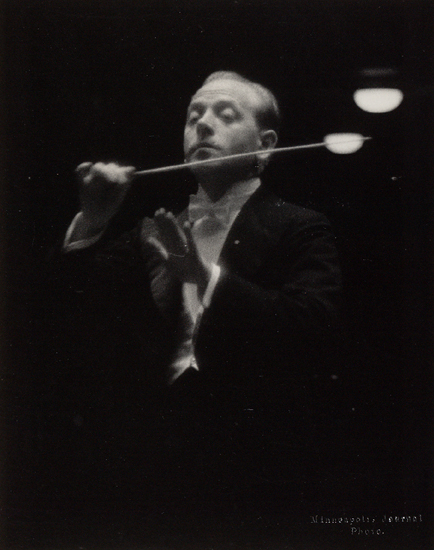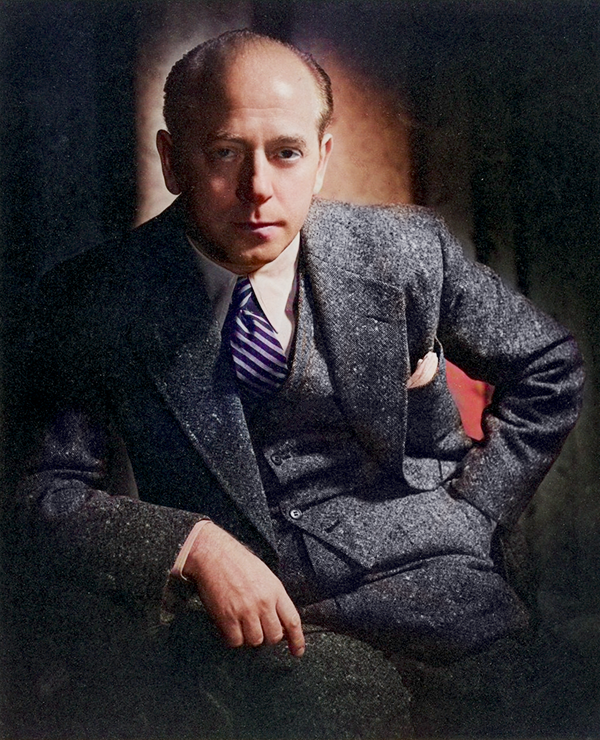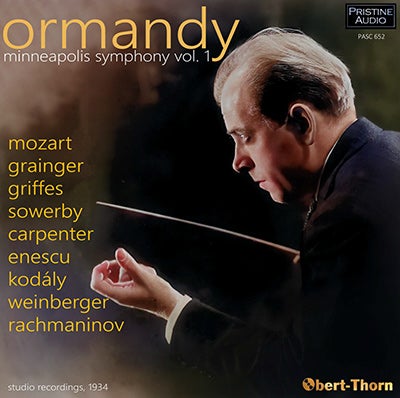
Eugene Ormandy
and the Minneapolis Symphony
Complete
Recordings ∙ Volume 1
CD 1 (77:10)
MOZART Serenade
No. 13 in G major, K. 525, “Eine Kleine Nachtmusik”
1. 1st Mvt. – Allegro (4:14)
2. 2nd Mvt. – Romanze (Andante) (4:25)
3. 3rd Mvt. – Menuetto
(Allegro) & Trio (2:12)
4. 4th Mvt. – Rondo (Allegro) (2:49)
Recorded 17
January 1934 ∙ Matrices: CVE 81524-1, 81525-1 and BVE 81526-1A & 81527-1
∙
First issued on Victor 8588 & 1698
5. GRAINGER
Country Gardens (2:09)
Recorded 16
January 1934 ∙ Matrix: BVE 81503-1 ∙ First issued on Victor 1666
6. GRAINGER
Shepherd’s Hey (1:59)
Recorded 16
January 1934 ∙ Matrix: BVE 81500-1 ∙ First issued on Victor 1666
7. GRAINGER
Londonderry Air (4:33)
Recorded 23
January 1934 ∙ Matrix: CVE 81502-3 ∙ First issued on Victor 8734
8. GRAINGER
Molly on the Shore (Irish Reel) (3:55)
Recorded 23
January 1934 ∙ Matrix: CVE 81501-3 ∙ First issued on Victor 8734
9. SOWERBY
Irish Washerwoman (2:09)
Recorded 23
January 1934 ∙ Matrix: BVE 81582-1A ∙ First issued on Victor 1761
10. GRIFFES
The Pleasure Dome of Kubla Khan (8:44)
Recorded 17
January 1934 ∙ Matrices: CVE 81522-1A & 81523-1A ∙ First issued on
Victor 7957
CARPENTER
Adventures in a Perambulator
11. En voiture (3:36)
12. The Policeman (3:39)
13. Hurdy-Gurdy (4:03)
14. The Lake (4:31)
15. Dogs (3:55)
16. Dreams (8:32)
Recorded 17, 22 &
23 January 1934 ∙ Matrices: CVE 81528-1A, 81529-1A, 81530-2A, 81531-2A,
81532-1A, 81533-2A & 81534-2 ∙
First issued on Victor 8455/8 in album M-238
17. ENESCU
Romanian Rhapsody No. 1, Op. 11 (11:35)
Recorded 16
January 1934 ∙ Matrices: BVE 81504-1, 81505-1A, 81506-1 & 81507-1A ∙
First issued on Victor 1701 & 1702
CD 2 (76:52)
KODÁLY Háry János
- Suite
1. Prelude: The Fairy Tale Begins (3:38)
2. Viennese Musical Clock (2:14)
3. Song (5:42)
4. The Battle and Defeat of Napoleon (4:03)
5. Intermezzo (4:31)
6. Entrance of the Emperor and his Court (3:04)
Recorded 17
January 1934 ∙ Matrices: CVE 81516-1 , 81517-1 , 81518-1 , 81519-1A ,
81520-1A & 81521-1 ∙
First issued on Victor 7951/3 in album M-197
WEINBERGER Polka
and Fugue from Schwanda the Bagpipe Player
7. Polka (2:15)
8. Fugue (5:56)
Recorded 20
January 1934 ∙ Matrices: CVE 81563-1A & 81564-1 ∙ First issued on Victor
7958
RACHMANINOV
Symphony No. 2 in E minor, Op. 27
9. Largo – Allegro moderato (15:41)
10. Allegro molto (7:30)
11. Adagio (11:30)
12. Allegro vivace (10:42)
Recorded 18, 19 &
22 January 1934 ∙ Matrices: CVE 81535-2, 81536-2A, 81537-2A, 81538-1A,
81539-1, 81540-1, 81541-1A, 81542-1, 81543-1A, 81544-1A, 81545-1 &
81546-1 ∙
First issued on Victor 8463/8 in album M-239
Eugene Ormandy ∙ Minneapolis Symphony Orchestra
Producer and Audio Restoration Engineer: Mark Obert-Thorn
Special thanks to Nathan Brown and Charles Niss for providing source
material
All recordings made in the Cyrus Northrop Memorial Auditorium,
University of Minnesota, Minneapolis
Total duration: 2hr 34:02
|
This week's Pristine
Classical newsletter
|
|
|
|
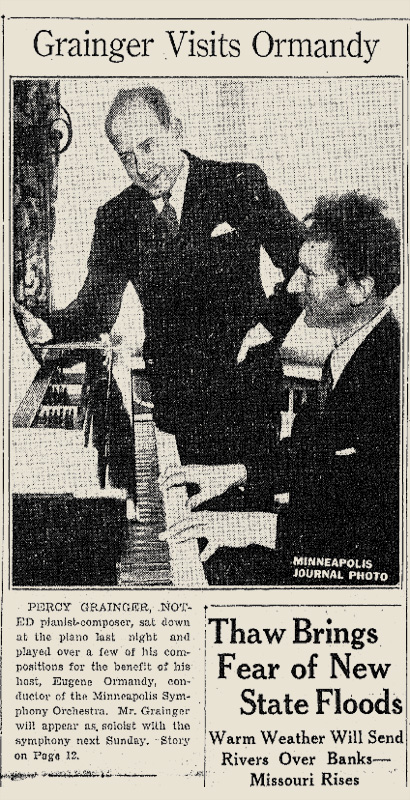 This week’s release is the first in
a new series devoted to a familiar
conductor. Hot on the heels of our
critically acclaimed releases
devoted to Eugene Ormandy’s early
years with the Philadelphia
Orchestra, we are excited to bring
you the first complete reissue of
his trailblazing recordings with the
Minneapolis Symphony. These featured
many discographic firsts, as well as
repertoire which Ormandy never
repeated on disc during his many
years in Philadelphia.
This week’s release is the first in
a new series devoted to a familiar
conductor. Hot on the heels of our
critically acclaimed releases
devoted to Eugene Ormandy’s early
years with the Philadelphia
Orchestra, we are excited to bring
you the first complete reissue of
his trailblazing recordings with the
Minneapolis Symphony. These featured
many discographic firsts, as well as
repertoire which Ormandy never
repeated on disc during his many
years in Philadelphia.
This volume – the contents of which were all, coincidentally, recorded eighty-eight years ago this month – gives a good sampling of the breadth of Ormandy’s repertoire at this time: disc premières of works by Kodály (the Háry János Suite) and American composers Charles Tomlinson Griffes (The Pleasure Dome of Kubla Khan) and John Alden Carpenter (Adventures in a Perambulator), as well as a group of popular Grainger folk dance arrangements never re-recorded by Ormandy, and his monumental first recording of Rachmaninov’s Symphony No. 2. All this, plus Mozart’s Eine Kleine Nachtmusik, Leo Sowerby’s Graingeresque Irish Washerwoman, and a longtime Ormandy staple, the Polka and Fugue from Jaromír Weinberger’s Schwanda the Bagpipe Player.
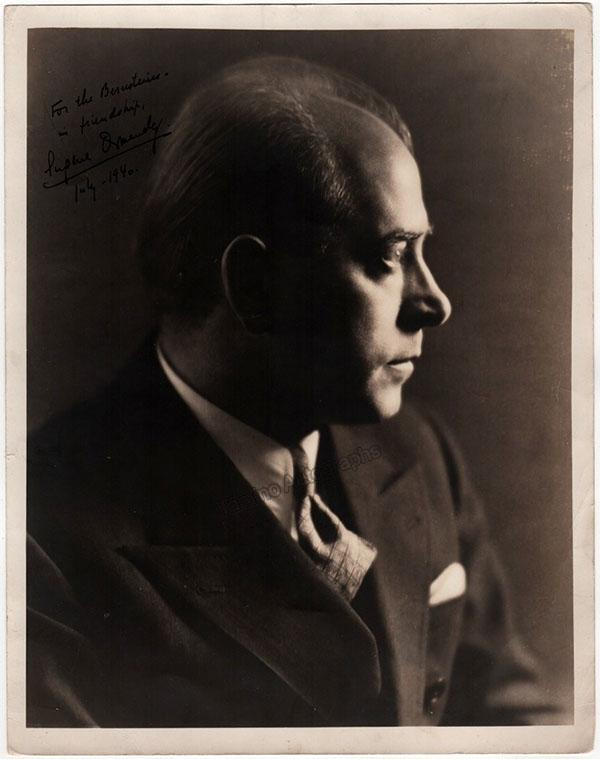 It’s notable that a time when
Stokowski and the Philadelphia
Orchestra were making discs with
half the number of players in a
small, unreverberant Camden church
due to Depression-era constrictions,
Ormandy led the full forces of the
Minneapolis Symphony on discs
recorded in their home concert
hall. As the booklet notes
reproduced below explain, this was
due to a provision in the
Minneapolis musicians’ contracts
that allowed recording sessions to
be held with no extra payment to the
players. The Victor label was quick
to seize on this, and over a couple
intensive weeks in January of 1934
and the following January, they made
dozens of recordings, including the
disc première of the orchestral
version of Schoenberg’s Verklärte Nacht,
as well as the Bruckner Seventh and
the Mahler Second (the last, during
a live concert performance). All of
these and more will be part of this
series. The sources used for the
present transfers were almost
entirely Victor “Z” and Red Seal
Scroll label pressings, providing
the quietest surfaces of any 78 rpm
issues of this material.
It’s notable that a time when
Stokowski and the Philadelphia
Orchestra were making discs with
half the number of players in a
small, unreverberant Camden church
due to Depression-era constrictions,
Ormandy led the full forces of the
Minneapolis Symphony on discs
recorded in their home concert
hall. As the booklet notes
reproduced below explain, this was
due to a provision in the
Minneapolis musicians’ contracts
that allowed recording sessions to
be held with no extra payment to the
players. The Victor label was quick
to seize on this, and over a couple
intensive weeks in January of 1934
and the following January, they made
dozens of recordings, including the
disc première of the orchestral
version of Schoenberg’s Verklärte Nacht,
as well as the Bruckner Seventh and
the Mahler Second (the last, during
a live concert performance). All of
these and more will be part of this
series. The sources used for the
present transfers were almost
entirely Victor “Z” and Red Seal
Scroll label pressings, providing
the quietest surfaces of any 78 rpm
issues of this material. 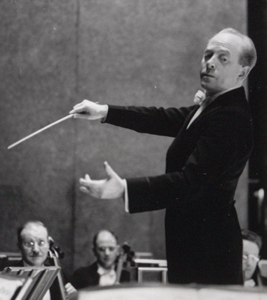 I
have to admit that I had a great
time working on this project. I
particularly enjoyed the Grainger,
Enescu and Rachmaninov works, each
of which exhibit the youthful energy
and élan brought to them by their
then 34-year-old conductor. Listen
to the excerpt from the Rachmaninov
on
I
have to admit that I had a great
time working on this project. I
particularly enjoyed the Grainger,
Enescu and Rachmaninov works, each
of which exhibit the youthful energy
and élan brought to them by their
then 34-year-old conductor. Listen
to the excerpt from the Rachmaninov
on