Hugo Kauder’s “Merlin” receives its belated world premiere in New Haven
June 11, 2013 at 11:14 am
By Aaron Keebaugh
His students remembered him as a polymath and consummate pedagogue. Lessons
with Hugo Kauder, one of his American pupils recalled, lasted three hours and
often covered a wide range of subjects beyond music.
The composer (1888-1972) was self-taught and self-guided, coming of age in
the Vienna of Arnold Schoenberg before moving to the U.S. in 1940. But he
eschewed atonality and considered it unnatural. Instead, as his prolific
output shows, he developed a musical style based on rich tonality and
Renaissance-style polyphony rooted in his own understanding of the natural
world.
Though Kauder’s music is little known, the Hugo Kauder Society is doing
much to remedy that. At Trinity Lutheran Church in New Haven, Connecticut
Sunday afternoon, the Society presented the world premiere of the composer’s
only opera, Merlin.
Kauder worked on Merlin for over a decade, starting in the
mid-1950s, and not completing the opera until 1966.
The story provides a slight twist on a familiar legend. The libretto, by
German philosopher Rudolf Pannwitz, tells of the prophetic Merlin as he
councils several kings (Vortigern, Pendragon and Uterpendragon) to bring peace
between the warring pagans and Christians. But by accident, he falls for the
seductive Viviane. As love between the two blossoms, she longs to know the
ways of magic. Merlin, going against the wishes of his master Blasius, teaches
Viviane the secret Magic of Death, which she uses to trap Merlin in a
whitethorn bush. Thus, the wizard can never return to the kingdom now
peacefully ruled by Artus.
The complex machinations of the plot, in Sunday’s performance, proved hard
to follow. In lieu of a full translation of the German text, English summaries
were projected onto a backdrop screen. Delivery wasn’t always timely with long
stretches of singing and dialogue passing before the corresponding
descriptions would appear.
And they were often too brief and too vague. One supertitle merely read
“Hero, Merlin!’ during a particularly lengthy aria early in the opera.
Listeners had to rely on their German skills, however fluent or rusty, to
fully grasp what Merlin and the other characters were up to. Most problematic,
though, the maladroit summaries proved a distraction and made it difficult for
the audience to fully appreciate the flow and subtlety of Pannwitz’s libretto.
Fortunately, Kauder’s well-crafted and appealing music was there to fill in
the gaps. The composer’s musical textures are largely contrapuntal, his
orchestrations warm and transparent. And the vocal lines flowed easily due to
his expressive text setting, based on the natural rhythms and inflections
reminiscent of Debussy’s Pelléas and Mélisande.
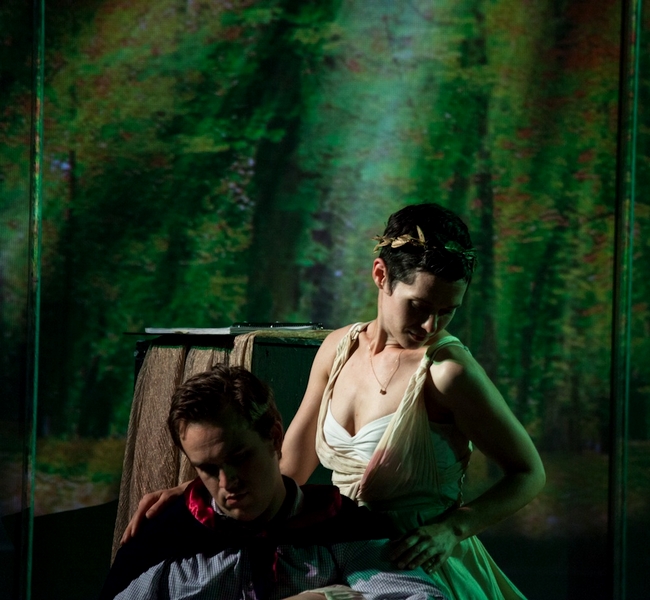
Bringing a particular shine to Kauder’s score were two charming singers in
the lead roles. Tenor Samuel Levine proved a fluent and robust Merlin. And
mezzo soprano Emily Marvosh’s sterling voice beamed in the role of Viviane.
The two also acted with fine, dynamic chemistry in their duets.
Strong performances also came from baritone Christopher Herbert, who
offered a full and resonant tone in dual roles as the Christian kings
Pendragon and Uterpendragon, and baritone Isaac Grier, who rendered the pagan
Vortigern with a stately voice.
As Merlin’s mentor Blasius, tenor Anthony Webb sometimes lacked power to
match the orchestration. But he put across the role of Gavan, a knight who
appears in the opera’s final scene, with more focus and force. Mezzo-soprano
Toby Newman, as a young Merlin in the opera’s prelude, seemed to have the most
problems with balance. Her milky voice unfortunately drowned beneath the waves
of the orchestral brass.
Other weaknesses were minimal. At times in the first act, the chorus
suffered from wavering pitch and uneven blend. But they fared better in the
second when they achieved a more solid ensemble sound. The chamber orchestra
played with control and expression and only rarely missed a strong attack.
Throughout, Adrian Slywotzky conducted the ensemble of musicians and singers
with steady energy and sensitivity.
Beth Greenberg’s economic staging of simple props, costumes, and colorful
projected imagery did plenty to establish Merlin’s fantastical world.
But it was the energetic music that won the day. And this performance of
Merlin is more than enough for listeners to pay Kauder’s music more
serious attention. hugokauder.org
The Hugo Kauder Society presents the world premiere of Hugo
Kauder's "Merlin - a fantastical opera", composed ca. 1966.
World premiere on Sunday, June 9th, 5pm, at Trinity Lutheran Church, 292 Orange
Street, New Haven, CT.
The Hugo Kauder Society’s Production of Merlin
http://www.kickstarter.com/projects/418945930/merlin-a-fantastical-opera?ref=live
The Hugo Kauder Society will mark the 125th anniversary of Kauder’s birth by presenting the world premiere of Merlin, one of Kauder’s final works and his only opera, in a staged concert in New Haven on June 9, 2013. Merlin is the story of a young man's search for truth and wisdom as he journeys through the fantastical realm of King Arthur. Recalling the mythology that inspired Richard Wagner and the magical world of Mozart’s The Magic Flute, Merlin is an innovative mix of musical styles and theatrical genres.
It is our pleasure to present the world premiere of this recently unearthed and restored opera at Trinity Lutheran Church, one of New Haven's finest examples of High Victorian Gothic architecture. Veteran New York City Opera Stage Director, Beth Greenberg, and Associate Conductor of the Boston Youth Symphony, Adrian Slywotzky, will direct this semi-staged concert production featuring six promising young singers supported by a 13-member orchestra and two choruses. Large-scale projections designed by artist Jamie Burnett, one of our area's most original lighting designers, will contribute to the ethereal atmosphere of the story.
As you can hear our wonderful singers say in the video, this project is exciting for a number of reasons. This opera has never been performed before, and we are really only getting our hands on the manuscript for the first time.
The singers, musicians and chorus members will get together with the artistic team one week prior to the performance for an intense week of rehearsing.
ARTISTIC TEAM
Stage Director – Beth Greenberg
Music Director – Adrian Slywotzky
Lighting and Projection Designer – Jamie Burnett
Stage Management - Jim Clark
Costumes/Props - Soule Golden
CAST
Merlin – Samuel Levine
Viviane/Mutter – Emily Marvosh
Young Merlin – Toby Newman
Kings Pendragon/Uterpendragon – Christopher Herbert
Blasius/Gavan – Anthony Webb
King Vortigern – Isaac Grier
Musicians: Naomi Senzer, flute, Andrew Parker, oboe, Julie Asuma Levene, clarinet, Craig Hubbard, horn, Will Eisenberg, horn, John Ehrenburg, trumpet, Maura Valenti, harp, Edson Scheid, violin, Stephanie Hug, violin, Ellen Higham, viola, Jill Levine, viola, Becky Patterson, cello, Zack Nestel-Patt, bass.
Chorus: Mary Lee Duff, Polina Mann, Joan Duffy, Barbara Fabiani, Carol Holloman, Terri Bennett, Catherine Miller, Angel Herrera, Steve Evans, Bob Santy, Mark Hanke, Attila Elteto, Bruce Larkin, Rachel Pelchat, Benedetta Cordaro, Louise Carrozza, Stephen Wynn.
Hugo Kauder (1888-1972)
Born in 1888, Hugo Kauder was a prolific chamber music composer who began his career in Vienna and fled to New York when the Nazis rose to power. While working in the United States, he developed a distinctive contrapuntal sound based on a "double scale" which is an inverted major scale for descending steps and normal scale for ascending steps. It creates a richness of color and tonal movement as intricate as the most chromatic of the 19th/20th Century composers and employs every step of the octave. At a time when many believed that Western tonality had run its course, Kauder’s more than 200 instrumental and 100 vocal works helped to expand upon traditional tonality rather than deny its relevance.The Hugo Kauder Society hopes to share Kauder's music with the next generation of musicians and listeners through innovative productions and competitions.
Merlin
Merlin is the result of a collaboration in the 1960's between Kauder and German poet, philosopher, and writer Rudolf Pannwitz (1881-1969). Its fantastical themes are reminiscent of the mythology that inspired the music dramas of Richard Wagner. In the story, Merlin comes from the Orient to the Western world in order to fight the lust for power and violence. Over the course of the drama, far-eastern wisdom is combined with the western cultural tradition, the mythical past merges with the future, and earthly hedonism unites with the will to the sublime. Merlin comes to realize that it is only in the perpetuity of love and death that his work can find a higher purpose. The opera's harmonic language, like its story, certainly owes much to the romanticism of Wagner. Its unique, enhanced tonality, however, incorporates the modernism of the 20th century while simultaneously evoking the music of Renaissance composers such as Ockeghem, Obrecht, and Josquin de Prez.