
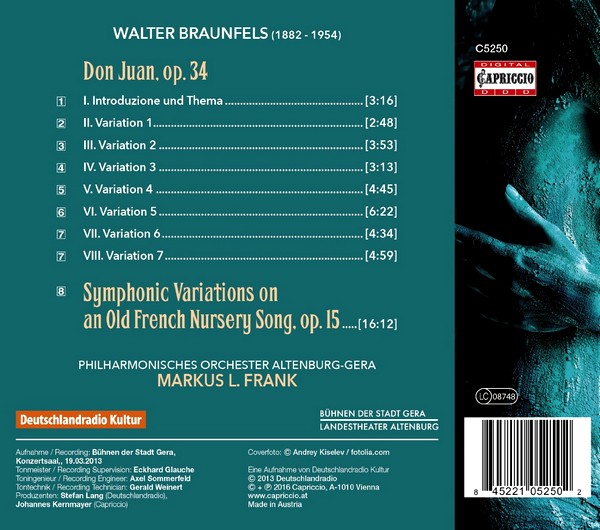
 Walter Braunfels (1882 – 1954)
| 1. | I. Introduzione und Thema 3:16 |
| 2. | II. Variation 1 2:48 |
| 3. | III. Variation 2 3:53 |
| 4. | IV. Variation 3 3:13 |
| 5. | V. Variation 4 4:45 |
| 6. | VI. Variation 5 6:22 |
| 7. | VII. Variation 6 4:34 |
| 8. | VIII. Variation 7 4:59 |
Walter Braunfels was applauded as a pioneering
representative of New Music. Leading conductors such as Hans Pfitzner, Ernst von
Schuch, Bruno Walter, Arthur Nikisch and Wilhelm Furtwängler performed his
orchestral works in major cities.
But following the Nazi seizure of power in 1933, as a 'half-Jew', even Braunfels lost all of his positions and was banned
from either performing or having his works performed; his name was
systematically deleted from musical literature and reference works.
Written in a classic-romantic style, Braunfels' 7-movement phantasmagoria “Don Juan”
incorporates variations on themes and motifs from Mozart's opera “Don Giovanni”,
which was premièred in 1787.
He thus deliberately placed himself in the German
classical-romantic traditions, which he sought to transfer to his 20th-century
resources in compositional style. The work was premièred in 1924, conducted by
Wilhelm Furtwängler.